 Kyoto Photoshoot
Gion Photography Rules: What You Can and Cannot Shoot
The gion photography rules trip up more visitors than any other piece of Kyoto etiquette, mostly because the district's own signage compresses two different restrictions into one confusing sentence. One rule governs a small set of private side-lanes; a separate, older custom governs photographing geiko and maiko anywhere in the city. Photographers who work these streets daily treat both as routine, and this page sets out exactly where the line runs, what a poster actually says, and how a booked session stays on the right side of it.
Quick answer
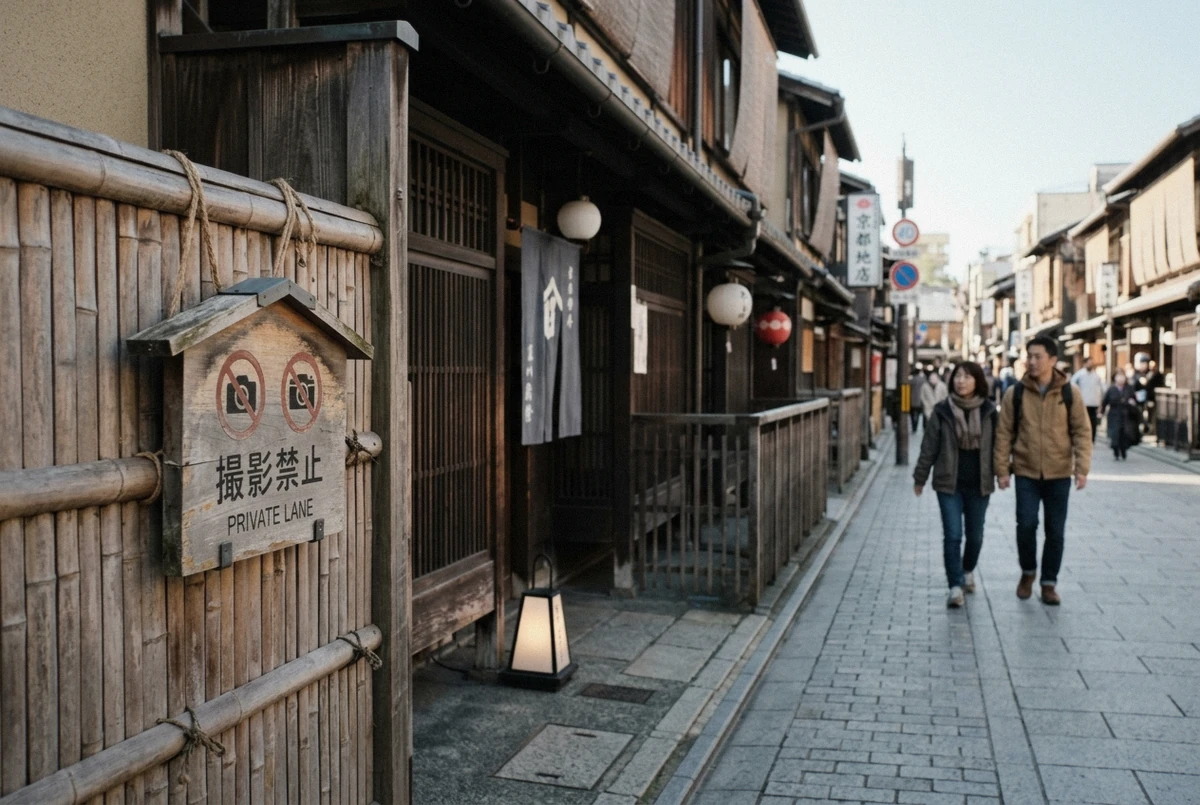
Gion's photography rules ban photography on a defined set of private side-lanes, first posted in October 2019 with a ¥10,000 fine, and separately expect that nobody photographs a geiko or maiko without her consent, anywhere in the city. Hanamikoji Street itself and the Shirakawa canal remain open to photography, which is why the session comparison still fills most bookings there.
Key takeaways
- The private-lane ban dates to October 25, 2019, posted by a residents' and shopkeepers' association, not a national law
- ¥10,000 is the fine printed on the signs; it is a community-issued penalty, not a police citation, and enforcement has never been fully clarified
- Hanamikoji proper and the Shirakawa canal around Tatsumi Bridge are public streets and stay open to cameras
- Photographing a geiko or maiko without her consent is treated as harassment across all of Kyoto, not just inside Gion
- See the full where-you-can-shoot table below, or skip straight to how a booked session in Gion stays inside the rules
What's Actually Banned, and Where
Gion's photography rules were never a blanket ban on cameras in the district. What changed on October 25, 2019 was narrower and more specific: a group of residents and shop owners along Hanamikoji, organized as a local association, voted to close a defined set of private side-lanes to photography and posted signs and multilingual flyers to that effect. These are not the main street. They are the narrow residential cuts that run behind the teahouses, the ones locals use to reach their own front doors, and they had become a shortcut for tourists chasing a candid shot of a geiko slipping between appointments.
The main thoroughfare, Hanamikoji Street itself, was never part of the ban. Neither was the Shirakawa canal a few minutes north, with its willow trees and Tatsumi Bridge. Both remain fully photographable, tripod aside, and both are exactly where the Gion district specialist session and most of the catalog's other Gion-based packages actually shoot. In March 2024 the district extended the same logic: additional multilingual warning signs went up beside more private roads, including Kosode Koji, and the local council stated plainly that entering those roads without business there would now draw the same posted penalty. Nothing about the 2024 update touched the public streets; it enlarged the private-lane list, not the ban's basic shape.
Where You Can and Cannot Shoot in Gion
| Street or area | Status | Notes |
|---|---|---|
| Hanamikoji Street (main thoroughfare) | Open | Public street; the district's most-photographed frontage and every Gion session's default backdrop |
| Gion Shirakawa canal & Tatsumi Bridge | Open | Public street; willow-lined canal a few minutes north of Hanamikoji |
| Private side-lanes off Hanamikoji | Banned | Signed since October 2019; ¥10,000 posted fine; these are residents' access paths, not public thoroughfares |
| Kosode Koji and other named private roads | Entry and photography banned | Added March–April 2024; multilingual signage, same posted penalty |
| Yasaka Shrine grounds | Open, kept brief | Sessions pass through; staged shoots inside the grounds are kept short and unobtrusive out of respect for an active shrine |
| A geiko or maiko you happen to pass, anywhere in Kyoto | Consent required | Not a lane restriction; a person's right not to be photographed while commuting to work |
The ¥10,000 Fine, and Who Actually Issues It
The number attached to Gion's photography rules everywhere online is ¥10,000, and it is worth being precise about what that figure actually is. It is not a national law and not a police citation in the way a traffic fine would be. The residents' and shopkeepers' association that runs southern Gionmachi posted it on the private-lane signage in 2019 as the penalty for photographing on those specific private roads, and news coverage at the time noted that how it would actually be enforced, by police, by committee members, or by volunteers, had not been made clear. Cameras were reportedly added to some of the private lanes as a deterrent, so the intent is real even where the mechanics stayed vague.
Separately, Kyoto's own published Gion manners notice, distributed by the Council of Southern Gionmachi, the Gion Kobu Tea Houses Association and the Gion Geiko Association, lists a different, older set of penalties tied to Japanese law rather than to the private-lane signs: obstructing someone's path or stalking carries up to 30 days' detention or a fine of less than ¥10,000, and grabbing someone's hand or clothing carries up to six months' imprisonment or a fine up to ¥500,000. Trespassing on private property separately carries up to three years' imprisonment or a fine up to ¥100,000 under Japanese law. In practice these overlap: a tourist who follows a maiko down a private lane to get a photo can be in violation of the private-lane sign, the anti-stalking statute, and the trespassing statute all at once, which is precisely the behavior the rules were written to stop.
Geiko and Maiko: the Consent Rule
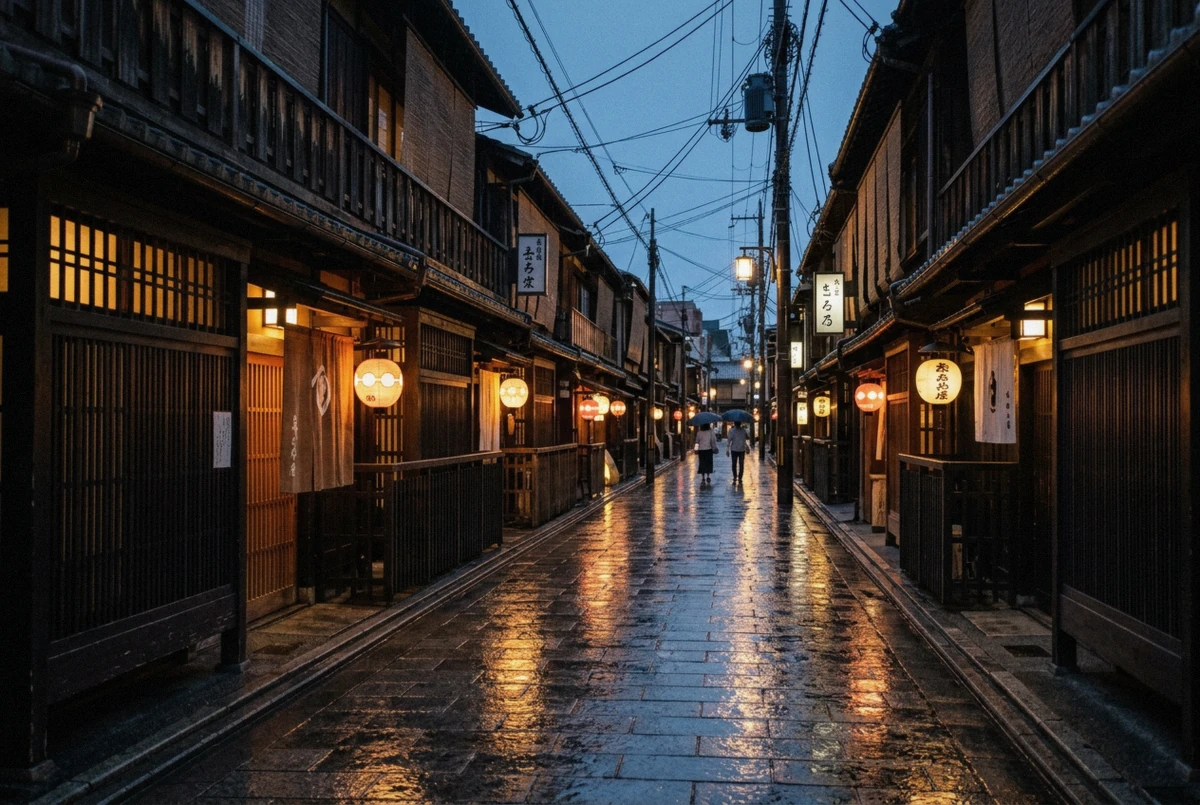
The consent rule sits apart from the lane restrictions and applies everywhere in Kyoto, not only inside Gion's private streets. Kyoto's official Gion manners guidance is explicit: do not stop, touch, follow, or take unauthorized photos or video of any geiko or maiko you see walking around the district. They are professional entertainers commuting between engagements, not performers stationed there for tourist photos, and the guidance is blunt about the reason it exists: reports of tourists grabbing at kimono, blocking a maiko's path to force a photo, and in at least one widely reported incident, damaging a geiko's clothing during a confrontation with a photographer.
On a public street like Hanamikoji, a candid photograph taken respectfully from a distance, without stopping or following anyone, generally falls outside what the guidance targets; the rule is aimed at pursuit and physical contact, not at the mere presence of a geiko in a wide shot of the street. If you want a guaranteed, posed portrait rather than a hoped-for candid glimpse, Gion Corner runs scheduled Kyomai dance performances most evenings, and several catalog sessions offer a kimono transformation that photographs like the real thing without asking anyone working a shift to stop for a stranger's camera.
How a Booked Session Stays Compliant
Every session in this catalog that shoots Gion works the same permitted public streets described above, which is the simplest reason booking one removes the guesswork rather than adding to it. The private photoshoot service and the Gion district specialist both name Hanamikoji, the Shirakawa canal and the lanes around Yasaka Shrine as their working ground; neither lists a private side-lane as a stop. One listing states plainly that photography is not permitted at Kiyomizu-dera and Yasaka Shrine's restricted areas and that its photographers, being Kyoto locals, follow the local rules as a matter of course, and the night session at the lit pagoda notes that Kyoto has a number of no-photography zones and that its photographer routes guests to the permissible areas around it instead.
That local knowledge is worth more than it sounds. A visiting photographer working from a guidebook map might not know which alley off Hanamikoji is a residential cut-through and which is a shop passage; someone who shoots the district weekly already does. If you are shooting solo rather than booking a session, the practical rule is the same one the professionals follow: stay on Hanamikoji proper and the Shirakawa banks, skip anything that looks like a private residential lane even without a visible sign, and never chase a geiko or maiko for a better angle.
Temple and Shrine Photography Limits
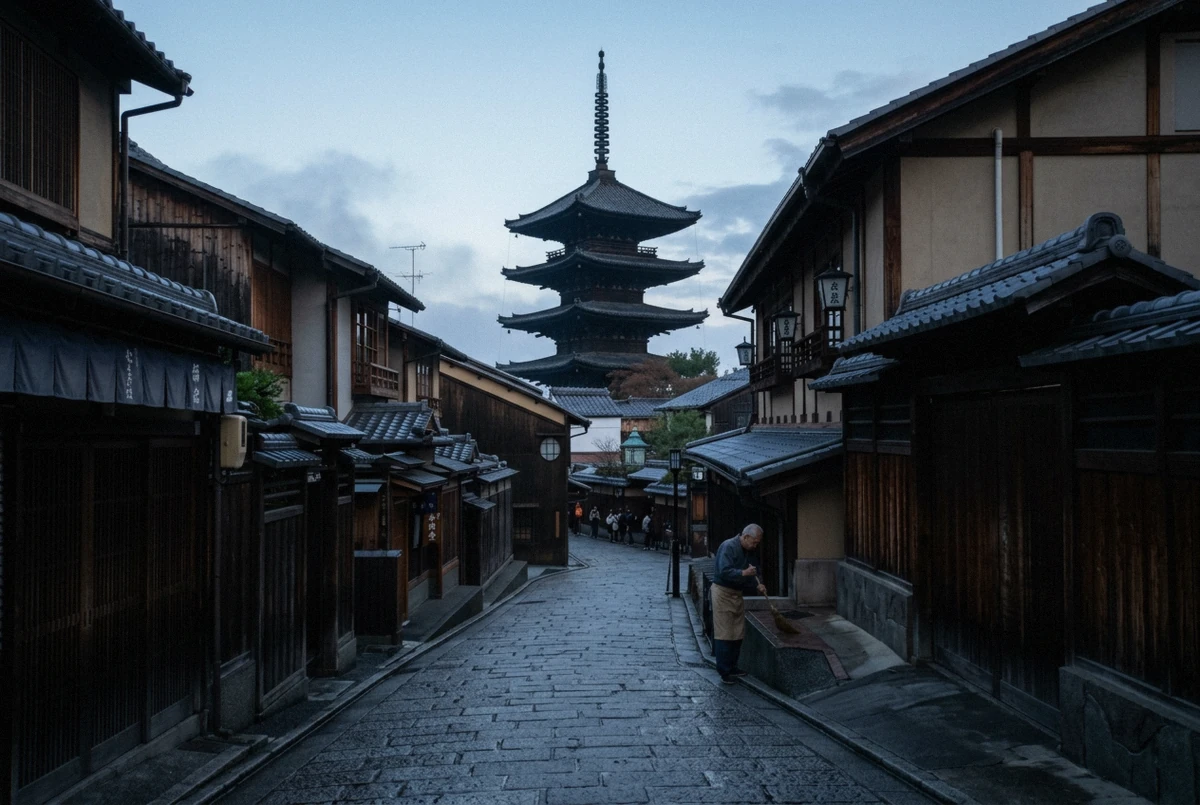
Gion's lane restrictions are only part of what limits a photoshoot in this part of Kyoto. The temples and paid gardens nearby run their own, stricter rules, and they are the reason nearly every kimono session in the catalog shoots the public lanes around a temple rather than the temple itself. Kiyomizu-dera's own visitor notice bans drones, monopods and tripods on the grounds outright, and separately forbids staged sessions entirely: weddings, cosplay shoots and fashion photography with models are all named as prohibited, along with commercial filming. That is why the private photoshoot service and other kimono sessions stage their Kiyomizu-area shots on Sannenzaka and Ninenzaka, the stepped public lanes below the temple, rather than inside its grounds.
The two paid gardens on the far side of town follow a similar pattern with slightly different specifics. Kinkaku-ji permits casual photography along its fixed viewing route but bans tripods, a rule reported as strictly enforced. Tenryu-ji's pond garden in Arashiyama allows photography generally but prohibits tripods and monopods as an obstruction to other visitors, and treats professional or staged sessions as something that needs the temple's own prior arrangement rather than a walk-in booking. Neither venue works for a catalog session as a result; the Arashiyama session shoots the bamboo grove that opens onto Tenryu-ji's north gate instead of the garden itself.
Staged Photography at Kyoto's Nearby Temples and Gardens
| Site | Casual photos | Tripods / monopods | Staged or professional sessions |
|---|---|---|---|
| Kiyomizu-dera | Allowed on the grounds | Banned, including drones | Banned: weddings, cosplay and fashion shoots named explicitly |
| Kinkaku-ji (Golden Pavilion) | Allowed along the viewing route | Banned, strictly enforced | Not practical; fixed one-way route leaves no room to stage |
| Tenryu-ji Garden | Allowed | Banned | Requires the temple's own prior arrangement; not a walk-in booking |
| Hanamikoji Street & Shirakawa canal | Allowed | Generally tolerated outside rush hours | Where every catalog kimono session actually shoots |
Tripods, Drones, and Everyday Lane Etiquette
Tripods are the recurring flashpoint in Gion's narrow lanes even where no sign specifically bans them, and it has nothing to do with the private-lane rule. A tripod planted across Sannenzaka or a Hanamikoji side street at 9am blocks a passage barely wide enough for two people, and it is shopkeepers and residents, not tourism officials, who end up asking you to move it. The working etiquette every catalog photographer follows is simple: handhold in the lanes, and save a tripod for open ground like the Kamo riverbank or the Nanzenji aqueduct, where there is room to set one up without becoming an obstruction.
Drones add a separate legal layer on top of the lane rules. Nearly all of central Kyoto, Gion and Higashiyama included, sits inside a Densely Inhabited District under Japan's aviation law, and flying a drone of 100 grams or more inside one requires a permit from the Ministry of Land, Infrastructure, Transport and Tourism, applied for at least ten working days ahead through the DIPS portal. For a one- or two-week visit that timeline effectively rules out casual drone photography anywhere in the district, independent of anything Gion's own signage says.
Which Rule Applies to You?
If you're shooting solo with your own camera on Hanamikoji or the Shirakawa canal
you're fine; these are public streets and always have been
If you're tempted by a quieter side-lane off Hanamikoji
check for the posted sign first; since 2019 that lane is very likely one of the private ones and carries the ¥10,000 penalty
If a geiko or maiko walks past you
let her pass without stopping, following, or raising a camera at close range; a wide candid shot from a respectful distance is a different matter from pursuit
If you booked a session through the Gion district specialist or a similar catalog listing
the photographer already routes you around every closed lane and restricted temple ground, so this whole page is background rather than a checklist
If you want a shot inside Kiyomizu-dera, Kinkaku-ji or Tenryu-ji's garden
expect casual photos only; staged and tripod work is banned at all three, which is why sessions shoot the public lanes around them instead
Gion Photography Rules: Common Questions
Are tourists still allowed in Gion?
Yes. Nothing about the photography rules closes the district itself. Hanamikoji Street, the Shirakawa canal, shops, restaurants and the shrine grounds remain fully open; only a defined set of private residential lanes are off-limits to entry and photography.
Is Hanamikoji Street itself closed to photography?
No. Hanamikoji is the district's main public thoroughfare and was never part of the 2019 or 2024 restrictions. It is where most of the catalog's Gion sessions, including the district specialist, actually shoot.
Can I bring a tripod into Gion?
There's no district-wide ban, but the lanes are narrow enough that setting one up during busy hours will block a passage residents and shopkeepers actually use. Handhold in the lanes and save a tripod for open ground like the riverbank.
What happens if I photograph a private lane by mistake?
The posted penalty is ¥10,000, issued by the residents' and shopkeepers' association rather than the police, and enforcement has never been fully clarified publicly. The straightforward fix is simply not entering a lane that carries a posted sign in the first place.
Can I photograph inside Kiyomizu-dera?
Casual snapshots are fine on the grounds, but staged sessions, tripods, monopods and drones are all explicitly banned by the temple's own visitor notice, which is why photoshoots work the public lanes below it instead.
What's the most recent change to Gion's photography rules?
In March and April 2024, additional multilingual warning signage went up beside more private roads, including Kosode Koji, extending the same 2019 penalty to a wider list of lanes. The public streets were not affected.
Why can't you photograph geisha in Kyoto?
Because they are commuting to work and were being physically blocked, followed and grabbed for photos. The women you see hurrying through Gion at dusk are geiko and maiko on their way to paid appointments, and the volume of visitors treating them as a photo opportunity is what pushed the district's associations to close the private lanes in 2019. Photographing them on public streets without consent is not criminalised, but it is the behaviour the whole rule exists to stop. Ask, accept a no, and never block a path.
What are the etiquette rules for taking photos in Japan?
Four rules cover almost every situation: no photography where a sign says so, and Japanese signage often uses a crossed-out camera rather than English; people in the frame need consent if they are recognisable and the shot is about them; temple interiors and paid gardens usually allow casual snapshots but forbid tripods and staged sessions, as the table above sets out; and residential lanes are somebody's doorstep, so shooting from the middle of one at 8am reads as intrusive whatever the law says.